

Rationale
I found this company back in July 2023, when I originally started tracking my investment portfolio. In short, this is a company that provides private-label manufacturing for fitness products, i.e., powders, supplements, etc., in addition to having patent rights to something called beta-alanine. The company had explosive growth during the pandemic years and decided to add capacity right at the top of the MLM bubble post-pandemic.
Like a good value investor, I assumed that reversion to the mean is a powerful force and that eventually this would recover. After all, they had already been through such a cycle in the early 2000s. The CEO is aligned and historical returns were not bad. Plus, they had closed one facility at the time I bought and reopened it shortly after (if you follow cyclical industries, this is usually a good sign — supply rationalization happens in cyclical troughs), and they were buying back shares.
The result was persistent and heavy losses. To be fair, when I bought it, the company was trading at 0.5x P/TBV and had a large cash cushion. Fast forward two years, and they burned through more or less $20M of cash (which was essentially all the cash buffer they had), had multiple covenant breaches, and profitability never came back. First it was expected in 2H 2024, then full year 2025, and now they have said that they expect a net loss for FY2026. They also stopped share buybacks and made no mention of serious cost-cutting initiatives.
Needless to say, what seemed to be an easy recovery play has turned into a nightmare from an investment standpoint.
What Went Wrong in My Process
Essentially, almost everything.
First, I assumed book value approximated more or less what would be replacement cost for this business. This is not necessarily wrong and it’s something that I still do (i.e., Patrizia and Wendel). But replacement cost comes with a premise: that people would actually be willing to replicate the business/factories of $NAII. It turns out that this business is not desirable. No one, despite all the tariff and near-shoring talks, stepped up to make an offer for the business.
Second, when management kept postponing profitability, I should have called it a day. Lesson for management teams: if your business is doing badly and you have no clue when it will recover (especially in cyclical industries), don’t promise things you cannot keep. You end up losing credibility. Instead, take a proactive approach and focus on what you can control: cold-closing underperforming facilities (CIVEO), reducing overhead (CIVEO), asset sales (PEOPLEIN), etc.
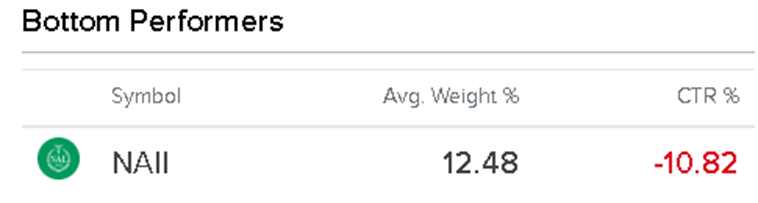
Finally, I sized this position way too large at the beginning. Thankfully, I exited a big part of it a few months ago, and now I’m selling the remaining 6% of my portfolio at a ~20% loss.
The amount of money this cost me since inception is pretty crazy, especially as my portfolio grew significantly over time. Hence the importance of selling your losses early, especially when the operating environment of the business is very cloudy and does not improve with time.
Conclusion
I would be lying if I said this doesn’t sting. I need to adopt a more dynamic portfolio sizing approach and not be afraid to average up if needed, sizing larger as business signals improve.
What I learned first and foremost is that if there are no catalysts or a management team actively trying their best to improve the business or capital allocation, the stock is simply not worth your time.
Gonçalo
 Value Hunter